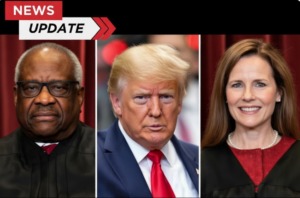
Supreme Court Curbs Trump’s Tariff Authority, Administration Explores New Legal Avenues
The Supreme Court has significantly restricted former President Donald Trump’s broad tariff-imposing powers, previously exercised under the International Emergency Economic Powers Act (IEEPA). According to CNN legal analyst Elliot Williams, speaking on The Bulwark’s “Illegal News” podcast, this ruling effectively closes off the expansive authority Trump once held, compelling the administration to seek out more limited legal mechanisms for future trade actions. This marks a critical shift in the executive’s ability to impose tariffs at will.
Interestingly, Justice Brett Kavanaugh’s dissenting opinion provided what many see as a practical “roadmap” for the administration. While advocating for strong presidential authority, Kavanaugh identified several alternative statutes permitting limited tariff imposition. These include the Trade Expansion Act of 1962, the Trade Act of 1974, and the Tariff Act of 1930. These alternative powers come with crucial limitations: tariffs must be temporary, feature lower maximum rates than Trump’s earlier measures, and demand specific presidential justifications. Kavanaugh succinctly stated that Trump had merely “checked the wrong statutory box” with his prior reliance on IEEPA.
Despite the judicial setback, Donald Trump has expressed approval of Kavanaugh’s dissent and has already begun implementing new tariffs using Section 122 of the Trade Act. However, Williams emphasizes that without IEEPA’s sweeping authority, Trump’s capacity to impose tariffs with the previous speed and scale is severely curtailed, akin to driving a less powerful car. In his State of the Union address, Trump affirmed his intention to maintain tariffs through these new legal pathways, even suggesting potential revenue could offset federal income taxes. Legal experts warn that Section 122 is a temporary measure, limiting tariffs to 150 days and requiring Congress to find further legal solutions for extension. Nevertheless, U.S. Trade Representative Jamison Greer confirmed the administration’s commitment to its trade policy by utilizing these different legal authorities.