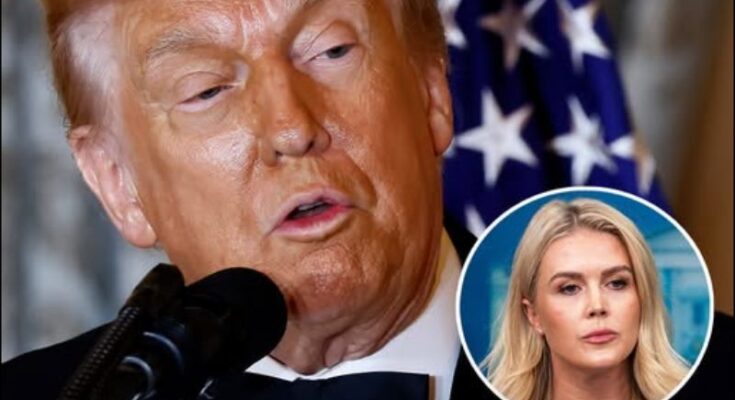
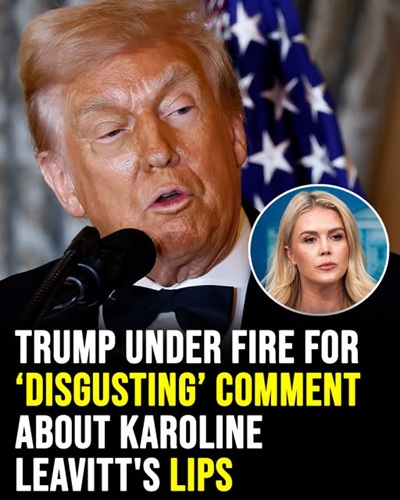
In the high-stakes environment of the White House, where every word is dissected and every gesture analyzed, few figures have drawn attention quite like Karoline Leavitt, the White House press secretary.
At just 28 years old, Leavitt has become one of the youngest individuals to hold this role in recent history, navigating the relentless glare of the media while managing a position that demands both poise and strategic communication.
Recently, however, Leavitt found herself at the center of a different kind of attention — one that is deeply personal and, for many observers, entirely inappropriate.
The attention came not from her own actions or public statements, but from remarks made by her 79-year-old boss, former President Donald J. Trump, during a rally in Mount Pocono, Pennsylvania, on Tuesday, December 9, 2025.
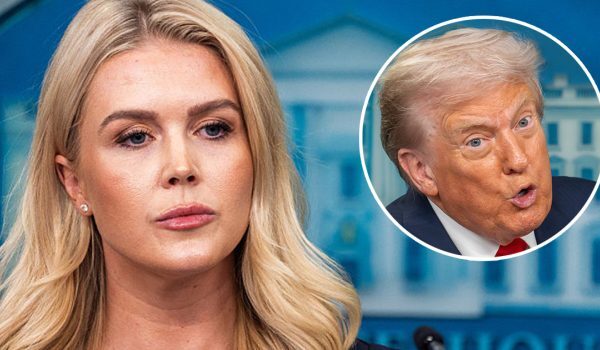
The Controversial Remarks
During the rally, Trump introduced Leavitt to supporters, referring to her as the administration’s “superstar.” While introductions of staff are common at political events, what followed drew swift criticism. According to multiple news reports, Trump said: “We even brought our superstar today, Karoline.
Isn’t Karoline great? You know, when she goes on television, Fox, like I mean, they dominate, they dominate when she gets up there with that beautiful face and those lips that don’t stop-op-op-op, like a little machine gun.”
The phrasing was notable not only for its focus on Leavitt’s physical appearance but also for its detailed and repeated reference to her facial features.
While some supporters described the comments as a compliment, critics across social media, journalism, and political circles called the remarks inappropriate, disrespectful, and degrading.
Public Reactions
Immediately after the comments were broadcast, social media erupted with responses. On X (formerly Twitter), users shared outrage, framing the remarks as indicative of a pattern in which Trump publicly reduced women in his administration to their appearance.
One viral post read: “BREAKING: Trump points out Karoline Leavitt’s beautiful face and her lips ‘that don’t stop pappaap paapaaap paaap like a machine gun.’ Trump is a disgusting fool.”
Others echoed the sentiment, emphasizing that such remarks were unprofessional and objectifying:
-
“Who says *** like this about a female that works for him? It’s beyond creepy and gross.”
-
“Disgusting. Who talks like that? She should feel cheap and disrespected. Gross.”
-
“Trump reducing a woman to her looks and the sound of her lips is grotesque, juvenile, and horrifyingly predictable.”
-
“Gross. I’d be mortified if my boss spoke about me like that.”
The pattern of reactions reflects a broader cultural critique: the public continues to grapple with the role of gendered commentary in professional settings, particularly when it comes from figures of authority.
Many viewed the remarks as emblematic of the challenges women face in male-dominated spaces, especially in politics.
The Broader Context: Trump’s History of Remarks
Leavitt’s situation is not isolated. President Trump has a documented history of making comments about the appearance of female journalists, politicians, and staff members. Some notable instances include:
-
November 2025: Trump told a Bloomberg White House correspondent to be “Quiet, piggy,” following a question about the Epstein files.
-
Days later: He referred to a CNN reporter as “nasty” and “stupid.”
While Leavitt’s introduction in Mount Pocono may have appeared complimentary to some, observers noted that the emphasis on physical traits rather than professional achievements echoed past patterns of commentary that many consider sexist or inappropriate.
Previous Incidents Involving Leavitt
The Mount Pocono remarks were not the first time Trump had publicly referenced Leavitt’s appearance. In October 2025, during a press gaggle aboard Air Force One following a Middle East diplomatic trip, Trump again focused on her physical features.
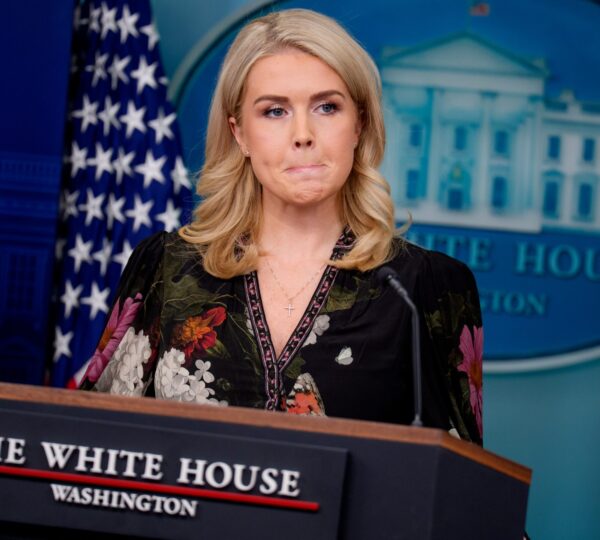
After discussing the peace deal he signed with leaders from Israel and Egypt, and mentioning Turkish President Recep Tayyip Erdogan, he abruptly shifted attention to Leavitt: “How’s Karoline doing? Is she doing good? Should Karoline be replaced?”
When a reporter responded, “That’s up to you, sir,” Trump continued, “It’ll never happen. That face…and those lips. They move like a machine gun, right?”
Similarly, in August 2025, during an interview with Newsmax, he described Leavitt as: “She’s become a star. It’s that face. It’s that brain. It’s those lips, the way they move. They move like she’s a machine gun.”
Across multiple events, the pattern is clear: Trump repeatedly highlights physical appearance, particularly Leavitt’s lips, in public forums.
Leavitt’s Response and Public Persona
Karoline Leavitt has not directly addressed the remarks in public statements. In interviews and social media posts, she has maintained a focus on her professional responsibilities, highlighting her commitment to press briefings, accurate communication, and serving as a liaison between the administration and the media.
She appears undeterred, sharing posts about the Mount Pocono event on X without personal commentary on Trump’s description of her appearance.
Leavitt has also been open about aspects of her personal life that draw public attention, such as her age-gap relationship. Her husband is 32 years older than she is, a fact she has discussed candidly in interviews.
For example, on the podcast Pod Force One with Miranda Devine, she was asked why she did not pursue relationships with men her own age. She responded simply: “Honestly, no, if you want to know the truth.”
Her willingness to discuss personal matters publicly, alongside her professionalism, has helped cultivate an image of confidence and resilience in the face of scrutiny.
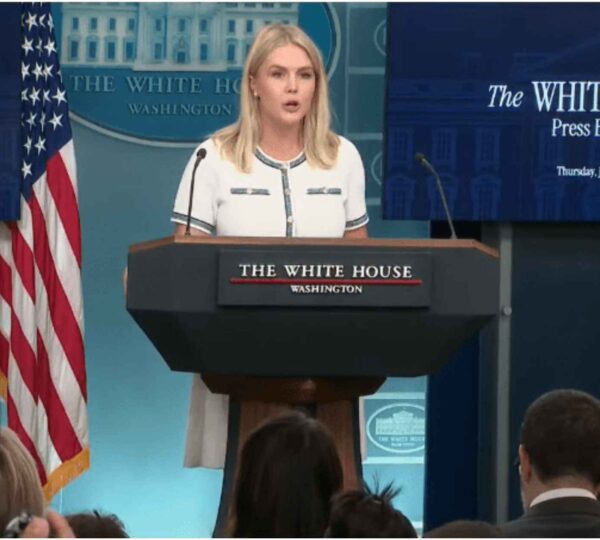
Gender and Power Dynamics in the White House
Leavitt’s experience is illustrative of larger conversations about gender, power, and professionalism in government environments.
The role of White House press secretary is historically high-pressure, involving daily interactions with journalists, managing crisis communications, and representing the administration to the public.
For a woman in her late twenties, navigating both professional demands and public commentary on appearance can add layers of complexity.
Experts in workplace dynamics note that comments focused on appearance rather than competency can have tangible effects on perception, credibility, and workplace morale.
While Leavitt has demonstrated poise, analysts argue that repeated remarks from high-ranking officials about a subordinate’s looks reinforce stereotypes and create a challenging professional environment.
Political observers have also pointed out that Trump’s style often blurs the line between personal admiration and public objectification, making it difficult for staff to publicly respond without attracting criticism or further attention.
The Public Debate
The remarks sparked a broader debate across news outlets, social media, and political forums. Supporters argued that Trump’s statements were intended as praise and reflect his unconventional, informal style of speaking.
Critics countered that regardless of intent, such commentary is out of place in a professional setting and diminishes the focus on competence and policy.
Columnists and commentators noted that the repeated pattern over months, and even years, suggests a structural issue regarding gendered commentary in politics, rather than a one-off incident.
In particular, women in high-profile roles often face double scrutiny: their professional output is evaluated alongside public commentary on their appearance, age, or personal life.
Leavitt’s Professional Achievements
Amid the attention to her looks, it is important to recognize Leavitt’s professional accomplishments. As press secretary, she has managed daily briefings, coordinated communication strategies, and handled media inquiries across multiple platforms.
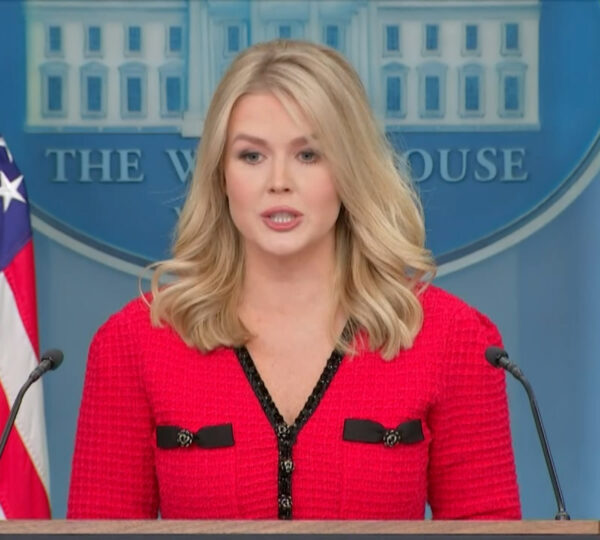
Her ability to navigate contentious topics with poise and maintain credibility with journalists reflects a high level of skill and dedication.
Leavitt’s tenure also underscores the challenges faced by younger staff members in high-pressure political environments, where experience is often measured against public scrutiny, age, and gender expectations.
Broader Cultural Implications
The public reaction to Trump’s comments reflects ongoing societal debates about respect, professionalism, and gender dynamics in workplaces.
The discussion has resonated not only in political journalism but also in broader conversations about how women navigate authority, media attention, and interpersonal dynamics in male-dominated spaces.
Observers have argued that Leavitt’s situation demonstrates the tension between public visibility and personal agency, highlighting the need for standards of communication that respect both the individual and the institution.
Conclusion
Karoline Leavitt’s experiences illustrate the complex interplay between media, politics, and personal identity in contemporary American governance.
At 28, she has navigated repeated public commentary on her appearance while performing one of the most demanding communications roles in government.
Her poise and professionalism underscore a larger point: professional competence and personal dignity are not determined by external commentary.
Despite repeated focus on her physical features, Leavitt continues to manage her responsibilities effectively, demonstrating resilience in the face of scrutiny.
The remarks by Trump, while controversial and widely criticized, also serve as a reflection point for public discourse.
They raise important questions about how authority figures should speak about their subordinates, the role of gendered commentary in professional spaces, and the responsibilities of media and citizens in evaluating leadership behavior.
Leavitt’s story — both as a young professional and as a woman navigating public commentary on her appearance — reminds us that workplace respect, competence, and professionalism should always take precedence over superficial observations.
Her calm response, coupled with her continued professional performance, provides a model of navigating complex power dynamics with integrity and resilience.
In a political environment often characterized by spectacle, Karoline Leavitt represents a case study in the intersection of youth, gender, and authority, demonstrating that the focus can remain on professional merit even amid personal scrutiny.
Her continued work in the White House, and her ability to remain composed under public pressure, is a testament to the challenges and resilience of young women in the highest echelons of American politics.